It usually starts around 3pm.
The stiffness creeps up the back of your neck. You reread the same email twice. You roll your shoulders, tilt your head, maybe book another massage for the weekend. It helps. For about three days. Then you are back at your desk, and the ache is back with you.
If that sounds familiar, you are not imagining it, and you are not weak for struggling with it. And it is costing you more than comfort. The lost focus, the shorter fuse in meetings, the evenings too drained to do anything after work: for a desk professional, chronic neck pain quietly taxes the exact things your career runs on.
According to a Singapore-based specialist who has spent 21 years in structural correction, the last 10 of those focused mainly on the neck, most desk workers are treating the wrong thing entirely.
The cycle nobody adds up
Think about what you have already spent. A course of sports massage. A few physiotherapy sessions. Maybe TCM, acupuncture, a $300 ergonomic chair, a standing desk, a new pillow. Each one helps for a little while. None of it holds.
"Those treatments are not scams," says Dr Will Kalla, Doctor of Chiropractic. "They do real work on the muscles. The problem is that for a lot of desk-bound professionals, the muscles were never the actual issue."
The question nobody had asked
Here is what most people with chronic neck pain have never had done: a proper, measured X-ray of their own cervical spine.
Not a scan someone glanced at and called "normal." An X-ray where the exact angle of the neck curve is measured in degrees.
Because a healthy neck is supposed to hold a gentle forward curve. When you spend years with your head tipped down toward a screen or a phone, that curve can flatten, or even reverse. And when the structure is off, the muscles around it have to work overtime just to hold your head up. That is the tightness. That is the fatigue. That is the fog by mid-afternoon. Massage releases those muscles for a day or two, then the structure pulls them right back.
"We do not guess," says Dr Kalla. "We measure it. Then the patient sees exactly what we are looking at, in degrees, on their own film."
Why has nobody told you this before?
Here is the uncomfortable truth behind years of failed treatments: the angle of your neck curve sits in a blind spot between two professions.
Your GP or specialist looks at an X-ray for damage. Fractures, tumors, severe degeneration. If none of that shows up, the report says "normal," you get painkillers or a physio referral, and you are sent on your way. Patients hear it constantly: "the doctor said the curve does not mean anything." Measuring the curve in degrees, and correcting it, is simply not part of standard medical training. It is not that your doctor failed you. It is not their field.
And a typical chiropractic clinic sits on the other side of the gap. Quick adjustments, a satisfying crack, relief that lasts a few days, and a standing appointment every week, indefinitely. The muscles and joints get attention. The underlying architecture is never measured, so it never changes.
This is the part most readers get wrong, so it is worth saying plainly: Dr Kalla's practice is not a typical chiropractic clinic. It is a structural correction clinic.
The difference is not branding. It is the entire model:
- Measured, not guessed. Every case starts and ends with X-rays. Progress is a number in degrees, not "how do you feel this week?"
- Correction, not relief. The goal is to rebuild the curve itself, so the muscles can finally stand down, instead of releasing them over and over.
- Designed to end, not to retain you. Programs run a defined course, typically 12 sessions for milder cases and 24 or more for stubborn ones, and then you graduate. Follow-up checks at 12 to 18 months confirm the correction is holding without ongoing treatment.
"Structure dictates function," Dr Kalla says. "If the pain went away but the structure never changed, the problem was never fixed. We renovate the neck. We do not rent you relief week by week."
Who is Dr Will Kalla
Dr Kalla trained at the Scandinavian Chiropractic College in Stockholm, Sweden, where he was the youngest student ever accepted into the program. He has 29 years of international clinical experience, 21 of those years focused on structural correction, and the last 10 mainly on the neck. The structural method used at his Singapore practice, R3NEW X™, was developed 12 years ago and is X-ray guided from start to finish.
He has been featured on Channel News Asia and in The Straits Times, and he personally conducts every initial assessment.
He is also, by his own patients' description, blunt. "Zero sugar-coating," as one put it. Which is part of why the results are worth looking at closely.
Case in point: the office worker who could not hold his mouse
A 57-year-old office worker came in with constant neck and arm pain, and numbness radiating down his right arm that had become severe enough that gripping a computer mouse was difficult. He rated his discomfort an 8 out of 10. Sports massage and conventional adjustments had given him zero lasting relief.
His X-ray told the story fast. His cervical curve was not just flat. It had reversed to negative 10 degrees, the opposite of a healthy neck. Clinicians have a blunt nickname for this pattern when the curve goes straight: "Military Neck." Patients tend to remember the moment they first see theirs on film.
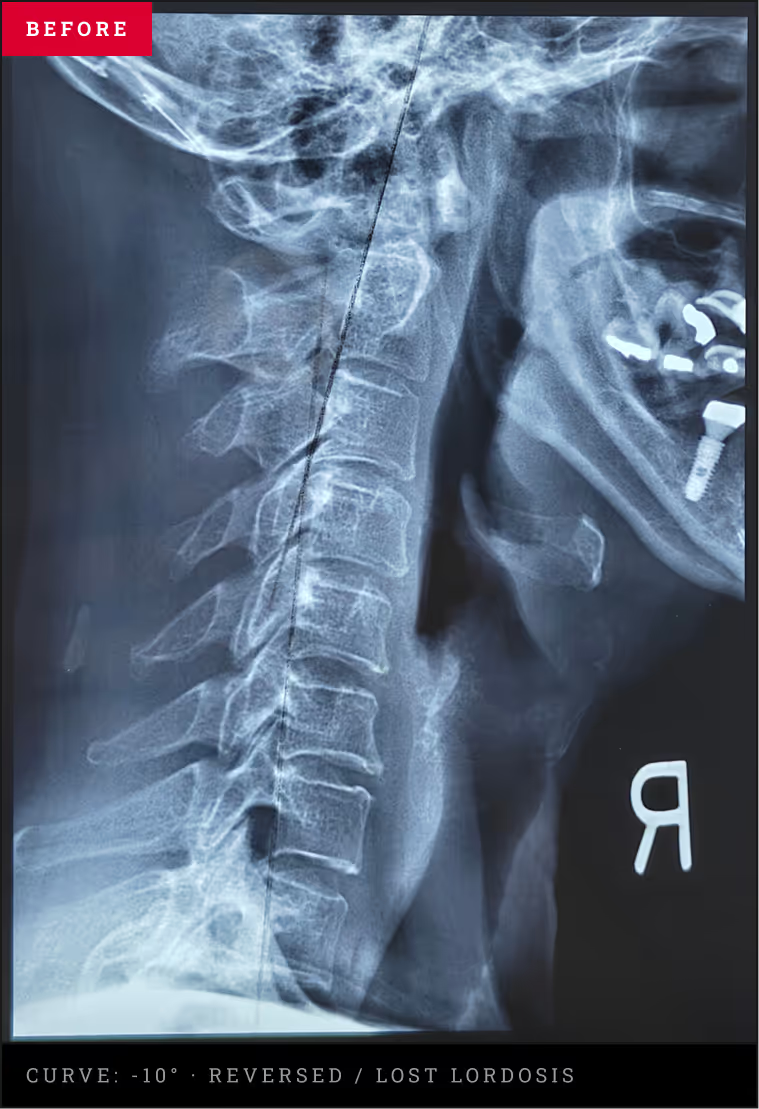
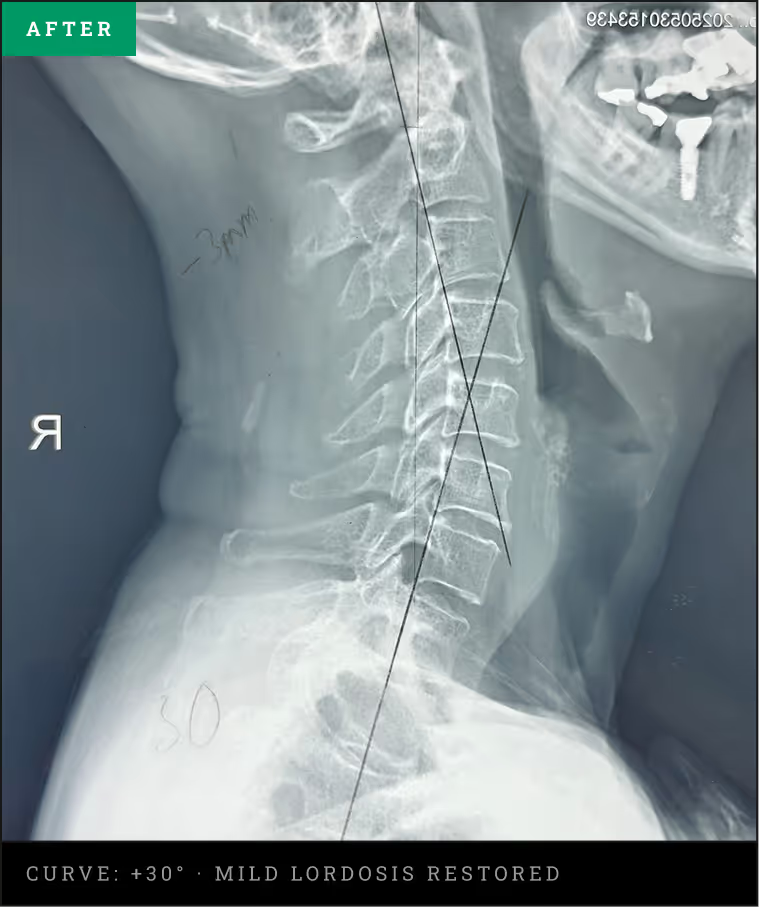
Actual patient films. Individual results vary.
Over 12 sessions of structural correction, his curve moved from negative 10 degrees to positive 24 degrees. By session 24 he reached positive 30 degrees, a textbook healthy curve. The arm numbness and back pain resolved within a month.
"I struggled with upper right back pain for three long months, and despite two months of sports massage, I saw no improvement. Discovering the problem was in my lower neck via X-ray was a breakthrough. My back pain vanished after the first few sessions, and in just one month of treatment, I am nearly fully recovered, with my cervical curve back to its normal alignment."
Verified Google review, 5 stars
Dr Kalla calls it one of the second-best structural responses his clinic has recorded. His point is not that every case goes this well. It is that a severe, long-standing reversed curve was measurably rebuilt by focusing on the structure instead of chasing the symptom.
No payment. No obligation. Speak to the clinic first.
And it is not only the dramatic ones
Another patient, Bernard, had nerve compression running into his shoulder and arm, real pain, not just numbness. He could not work more than ten-minute stretches at his computer. His X-ray showed his head angled forward, pulling his upper back into a hunch, which in turn strained his lower back. Even driving set off a chain of neck, shoulder and back aches.
"I am one month into my treatment. It is 90% gone. The latest X-ray shows massive improvements. You do not need to be a professional to see the difference. I no longer hunch. My lower back does not ache. I can stand for hours with no discomfort. It is worth every single cent."
Verified Google review
The part most clinics leave out
Here is something unusual for a page like this: not every case reaches 100%.
One patient came in rating his years-old neck tightness a 4 out of 10. After a long course of treatment, he rated it a 2 out of 10. Better, not gone. And he said so publicly.
"Even though I was not fully cured, I am still appreciative of the effort and treatment. For people who have neck issues, finding DrNeckPain will definitely get some relief."
Verified Google review
Dr Kalla's clinic publishes cases like that one on purpose. "Structural correction is not magic," he says. "It is measurable. Some necks correct beautifully. Some improve a lot without hitting a perfect number, especially older or heavily degenerated ones. We would rather tell you that honestly than promise you everything."
How the correction actually works
The protocol runs in three phases, the same sequence for every case, adjusted to the individual and re-measured on X-ray along the way.
- RELEASE. Loosen the deep tissue restrictions and prepare the neck for realignment.
- RESET. Reset joint mobility and structural alignment at the neurological level.
- RECALIBRATE. Retrain the brain's posture map so the corrected position starts to hold on its own.
Progress is confirmed on film, so you see the degree change, not just how you say you feel that week.
"But my doctor said to avoid chiropractors"
Here is the surprising part: Dr Kalla largely agrees with that advice.
Fast, forceful neck cracking on an unmeasured, possibly degenerated spine is exactly what a cautious doctor is warning you about, and it is exactly what does not happen at a structural correction clinic. Nothing is done to your neck before your films are taken, read and measured. Every step of the correction is X-ray guided, and progress is verified on film, the same evidence language your doctor speaks.
Many patients arrive carrying that warning. They tend to relax at the first consultation, when the conversation starts with imaging and measurements instead of a crack.
As for whether the changes last: the structural corrections shown on X-ray are real changes to alignment, and the program is designed to end, with self-maintenance afterward, rather than lock you into weekly visits forever. Milder cases often need around 12 sessions. More stubborn or degenerated cases can take 24 or more.
What happens if you do nothing
The uncomfortable part. A collapsed or reversed curve does not tend to fix itself. Left alone for years, it is the kind of loading that leads to disc wear, nerve irritation, and in the worst cases the degeneration that eventually puts surgery on the table.
A 63-year-old engineer came in with exactly that: an S-shaped neck, bone spurs, worn discs, two years of stiffness, and a real fear of where it was heading. Over six months his curve was rebuilt to a realistic target for his age, and his stiffness dropped sharply. No surgery. The earlier the structure is mapped and corrected, the easier that road tends to be.
The decision in front of you
You can keep booking the massage that lasts three days. Plenty of people do, for years. At Singapore prices, that habit quietly costs thousands a year, and the structure underneath never changes.
Or you can see your own spine on film and stop guessing.
This month, the clinic has opened 30 assessment spots
Here is what those 30 people get, in one visit:
- •A full-spine X-ray, all 4 films, FREE.Every region on film, and your cervical curve measured in degrees. Not "looks fine." A number. Normally $150 to $200 on its own at an imaging centre.
- •The initial consultation with Dr Kalla himself.He reads your films with you and shows you exactly what is driving the pain.
- •A trial session of the R3NEW X™ protocol.You experience the actual correction process.
The consultation and trial session together are normally $128. Add a full-spine X-ray on its own and you are looking at $278 to $328. The first 30 bookings this month get all of it, X-rays included, for $168, and your payment is what reserves the spot.
And it is built for people with a working week. The clinic is a five-minute walk from Bugis and City Hall MRT, sessions fit around office hours including lunch slots, and there is no medical certificate or time off needed.
Where should we send your booking details?
The clinic is at 420 North Bridge Road, #02-20 North Bridge Centre, Singapore 188727, a five-minute walk from Bugis and City Hall MRT. You can also chat with Dr Neck Pain on WhatsApp.
Two honest notes. First, this is capped at 30 because Dr Kalla personally conducts every initial assessment, and there are only so many hours in a month. When the spots are gone, they are gone. Second, if your films show you are not a candidate for structural correction, he will tell you that plainly at the consultation. You keep your films either way, and you will know more about your neck than years of guessing ever told you.